
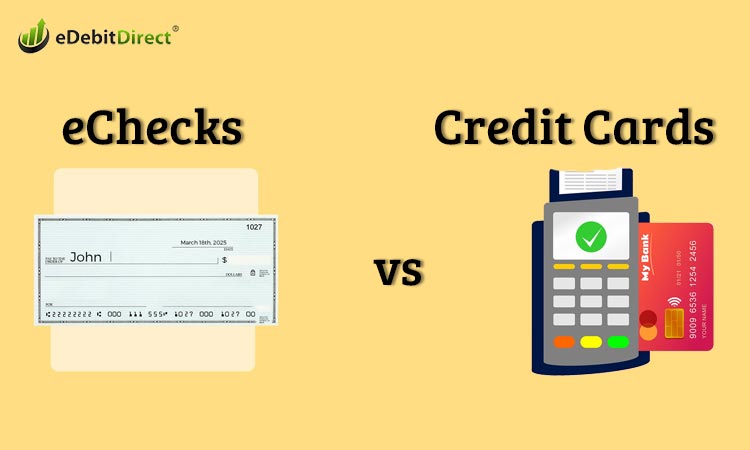
Businesses rely on different payment methods to collect funds from customers. Two of the most commonly used options are eChecks and credit cards. While both allow electronic payments, they operate through distinct processes and create different cost, speed, and risk considerations. Understanding how eChecks and credit cards compare helps businesses select the payment method that best supports their financial structure and customer expectations.
eChecks vs. credit cards
eChecks, also known as electronic checks or direct debits, function as a digital version of traditional paper checks. Instead of handling a physical document, payment details such as bank account information and payment amounts are transmitted electronically. This process removes the need to mail checks, wait for deposits, or manage manual handling. Because eChecks move funds directly from a customer’s bank account, they typically involve lower processing costs than credit card transactions.
Another important distinction is risk exposure. Credit card payments can be subject to chargebacks and disputes, which may create added administrative work and financial uncertainty. eChecks generally present a lower risk in this area, making them appealing to businesses that prefer predictable payment handling and reduced operational friction. For companies that process recurring payments or higher transaction amounts, this structure can offer greater control and cost stability.
Credit cards operate differently. They allow customers to complete payments quickly using a card issued by a financial institution. These transactions are processed by payment networks, often resulting in faster access to funds for businesses. Credit cards are widely accepted and familiar to consumers, which can make them an attractive option for businesses that want to remove friction at checkout and support impulse or time-sensitive purchases.
Because credit cards are commonly used across many countries, they also appeal to businesses seeking broader customer reach. Customers often prefer cards for convenience, especially when shopping online or making immediate purchases. This familiarity can influence conversion rates, particularly for businesses focused on speed and ease of payment.
Cost, timing, and customer behavior
When comparing eChecks vs. credit cards, businesses should carefully consider transaction fees. Credit card payments typically include higher processing costs due to network fees and intermediary services. Over time, these costs can have a noticeable impact on margins, especially for businesses processing frequent or high-value transactions. eChecks, by contrast, usually offer lower processing expenses, which can make them more suitable for businesses focused on long-term cost efficiency.
Processing times also differ. Credit card transactions are often authorized and settled quickly, giving businesses faster access to funds. eCheck transactions may take longer to clear, depending on banking processes. Businesses must weigh whether immediate fund availability or reduced costs better aligns with their cash flow needs.
Customer preference plays an equally important role. Some customers are more comfortable using credit cards, while others prefer bank-based payments. The ideal payment method depends not only on internal business priorities but also on how customers expect to pay.
Selecting the right option for your business
For businesses that prioritize lower processing costs, reduced dispute exposure, and direct bank-to-bank payments, eChecks can be a strong choice. For businesses that value speed, familiarity, and wide consumer adoption, credit cards may be more appropriate. In many cases, the decision depends on the type of transactions being processed and the customer profile being served.
Read also:
eChecks: a sustainable payment solution for businesses
Final thoughts on eChecks vs. credit cards
There is no universal answer when choosing between eChecks and credit cards. Each method supports different operational needs and customer behaviors. By reviewing costs, processing timelines, and payment habits, businesses can select the option that aligns with their financial goals and day-to-day operations.
eDebitDirect.com – Creative payment solutions for every business.